
Teamwork and Communication Skills for Kids Through Group Discussions

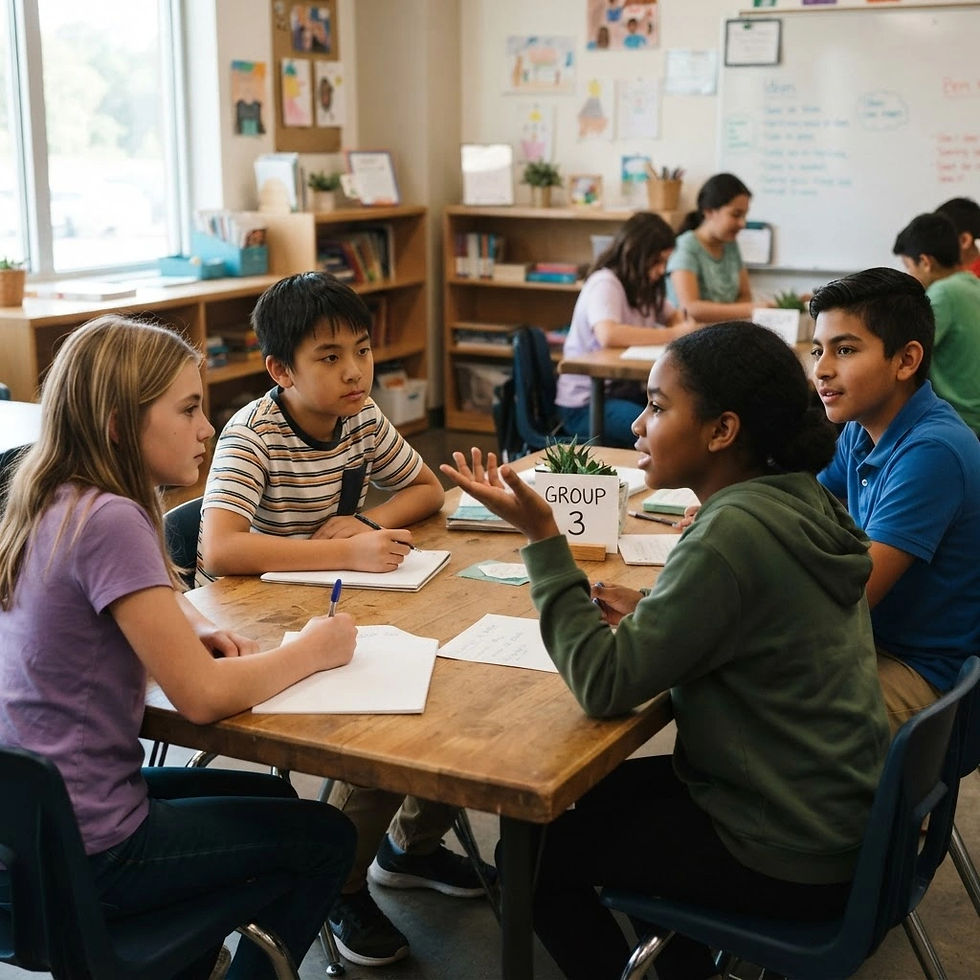
A classroom group activity can look lively without being productive. Several children may talk at once while one student makes every decision and another says almost nothing. The difference between activity and learning is often structure: clear roles, shared expectations, and time to reflect.
Teamwork and communication skills for kids need more than simply placing children in a group: they grow through practice, listening, and shared responsibility.
When group discussions are designed thoughtfully, children can practice communication and leadership skills in the same activity.
Teamwork and Communication Skills for Kids Begin with Purpose
Instead of asking students to “discuss this topic,” offer a specific task: “Choose one improvement for the school library. Agree on a proposal and prepare a one-minute explanation.”
Now the group must identify priorities, compare options, handle disagreement, and communicate a result. There is a reason to listen.
Four roles that rotate
Facilitator: makes sure the group understands its goal and invites contributions.
Idea builder: adds examples and develops suggestions.
Questioner: asks for reasons, clarification, and missing perspectives.
Summarizer: explains the group's conclusions fairly and clearly.
Rotate roles in future sessions. Children who love presenting can practice listening; children who prefer observing can begin with summarizing before trying facilitation.
Model a useful discussion pattern
Try this progression:
1. Each student thinks quietly and writes or draws one idea.
2. Everyone has a short chance to share or pass.
3. Group members ask clarifying questions before evaluating proposals.
4. The group chooses a direction and explains its reasoning.
5. Members reflect on who was heard and what could improve.
The quiet think-time matters. Not every learner can formulate an idea while others are speaking, and not every child wants to compete to enter the conversation.
The connection to leadership
Children experience leadership when they manage competing perspectives responsibly. They learn to say, “We have two options—what matters most?” instead of “My idea is best.” They also practice changing course when a teammate raises a valid concern.
The CASEL relationship skills framework emphasizes active listening, collaboration, and constructive problem-solving. It is a useful basis for designing group experiences that treat leadership as shared work rather than individual status.
A ten-minute home version
Ask the family to design a pretend playground with only three features. Each person proposes one feature and explains why. Then choose three together. Give one child the job of summarizing everyone's ideas; give another the job of asking one follow-up question. A parent can facilitate without deciding the outcome.
Afterward, ask: “Whose idea changed your thinking?” and “Did we listen to everyone?” These reflection questions are as valuable as the final playground design.
At Everlove Academy, structured discussions and peer feedback complement speeches, argument-building, and leadership activities. Our after-school programs and in-person classes offer opportunities to practice these skills with other learners.
A small shift for adults: Praise the child who makes room for another voice, not only the child who talks the most.
Frequently asked questions
What if one child dominates the group? Use timed turns, rotating roles, and an explicit goal of hearing multiple viewpoints. Praise the dominant speaker when they ask a question or build on someone else's idea.
What if a child never volunteers? Offer preparation time, the option to contribute through drawing or notes, and a defined low-pressure role. Do not assume silence means disengagement.
How should children handle disagreement in a team? Ask them to name the shared goal, compare reasons, and choose a fair decision method. The process should be explained in language that every group member understands.
Make the reflection concrete
End a group activity with each student completing two sentences: “One idea I added was…” and “One idea I heard from someone else was…”. The second sentence makes listening just as visible as speaking.